
Infection Preventionist Nursing job in Karachi
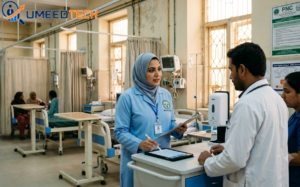
Infection Preventionist Nursing job in Karachi
By : Umeedtech
It was mid-August, right in the thick of Karachi’s monsoon season. I was working a chaotic shift in a busy medical ward when the head of nursing stopped by with a clipboard. Water stains were creeping up the corridor walls from the humidity, the ward was at maximum capacity, and we had just identified our third case of a highly resistant bacterial strain in the same bay. The tension was palpable.
The head nurse looked at me and said, “We need someone to take over the Infection Control auditing for this block. Permanent position. Are you up for it?”
That was my accidental entry into the world of an Infection Preventionist (IP) Nurse—or IPC (Infection Prevention and Control) Nurse, as many hospitals here call it. At the time, I thought it just meant telling people to use hand sanitizer and making sure the sharp containers weren’t overflowing. I was completely wrong.
Transitioning from bedside nursing to a specialized IP role in a massive metropolis like Karachi is an entirely different ballgame. It turns you from a healthcare provider into a clinical detective, an educator, and occasionally, the most unpopular policy enforcer in the building. If you are a Registered Nurse (RN) looking to pivot into this specialized domain, let’s talk about what the job actually entails, the realities of the Karachi market, and how you can land a solid role.
What Does an Infection Preventionist Actually Do Here?
In a textbook, infection prevention sounds highly clinical and structured. In a major tertiary care hospital in Karachi—whether it’s legacy institutions like Liaquat National, Aga Khan University Hospital, Indus Hospital, or specialized setups like The Kidney Centre and the Friends of Burns Centre at Civil Hospital—the job is highly dynamic and fast-paced.
You are responsible for protecting three distinct groups: patients, healthcare workers, and the community. Your daily routine is split between three core pillars:
-
Surveillance and Auditing: You aren’t sitting at a desk. You are walking the floors, checking the Central Sterile Supply Department (CSSD), auditing ICU compliance, and monitoring surgical site infections.
-
Outbreak Investigation: If an unusual number of patients in the Neonatal ICU (NICU) suddenly develop a similar fever spike, you track the source. Is it a broken autoclave? A contaminated batch of IV fluids? Poor hand hygiene compliance during a shift change? You trace the footprints of microscopic bugs.
-
Staff Education: This is the hardest part. You have to train everyone from senior consultants and post-grad residents to ward boys, janitorial staff, and AC maintenance technicians on strict biosafety and waste disposal protocols.
The Landscape of IP Nursing in Karachi
The healthcare infrastructure in Karachi is deeply divided, and the expectations for an Infection Preventionist vary wildly depending on where you apply.
1. Private Tertiary Care & Specialized Institutes
Hospitals like Aga Khan, Liaquat National, South City, or OMI Hospital have highly structured, dedicated IPC departments. They follow international metrics like Joint Commission International (JCI) standards or specific International Patient Safety Goals (IPSG). Here, you will use dedicated software systems to track infection rates, write extensive statistical reports, and present data directly to the hospital’s executive board.
2. Public Sector & Trust-Run Networks
Massive networks like Indus Hospital & Health Network, Civil Hospital, or JPMC handle incredible patient volumes. The challenge here shifts from pure data collection to resource optimization and crisis management. You might find yourself managing critical isolation protocols during an influx of dengue, typhoid, or extreme burn wound infections where space is limited and turnover is incredibly fast.
3. Dedicated Specialty Centers
Places like The Kidney Centre or individual dialysis networks frequently hire dedicated IPs because their patient demographic is profoundly immunocompromised. A single systemic infection breach in a dialysis unit or a transplant ward can be catastrophic, making the IP nurse one of the most critical risk managers on the payroll.
How to Position Yourself to Get Hired: A Step-by-Step Guide
If you look at recent job boards across Karachi, you will notice a steady stream of openings for Infection Control Nurses. Hospitals are realizing that robust prevention saves them millions in extended bed stays and legal liabilities. Here is how you bridge the gap from a general staff nurse to a specialized candidate.
Step 1: Meet the Baseline Educational Grid
You cannot skip the academic foundations. To even get your resume past the initial HR filtering screen at a reputable Karachi hospital, you need:
-
A valid, active Pakistan Nursing Council (PNC) registration.
-
A BSc Nursing (BSN) degree or a Post-RN BScN. While some smaller setups accept a classic Diploma in General Nursing with extensive experience, mid-to-large tier facilities explicitly prefer a four-year degree.
Step 2: Acquire Targeted Certification
If two nurses with identical ward experience apply for an IP opening, the one with specialized training always wins.
-
Look for local short courses, workshops, or a Diploma in Infection Control from recognized institutes (such as AKU, DUHS, or the Infection Control Society of Pakistan).
-
Having even a 3-month or 6-month certification on your CV proves to talent acquisition teams that you understand epidemiological concepts, sterilization science, and biomedical waste management frameworks before they even train you.
Step 3: Speak the Language of Data in Your Resume
When updating your CV, stop listing generic tasks like “Took care of patients” or “Maintained cleanliness.” Instead, frame your current ward experience through an infection control lens:
Example: “Actively monitored central line-associated bloodstream infection (CLABSI) risks in a 20-bed medical ICU, ensuring 100% staff adherence to sterile barrier protocols.”
Example: “Coordinated with the CSSD unit to track and resolve tool sterilization delays, reducing surgical ward prep bottlenecks.”
3 Critical Mistakes I Made (And What They Cost Me)
When you cross over from clinical nursing to infection prevention, your mindset has to shift. I tripped over several unwritten professional rules early on:
1. Being the “Hygiene Cop” Instead of a Collaborator
When I started, I used to walk into wards with my clipboard, pointing out errors strictly. “Why isn’t that sharp box replaced?” “Why did you skip the hand-rub step?” Naturally, the ward nurses started hiding things from me or resenting my audits.
-
The Lesson: You cannot enforce safety through fear or annoyance. You have to build alliances with the ward in-charges. Instead of just marking a failure on your checklist, pull the nurse aside and ask, “Hey, I noticed the hand rub dispenser is empty here. Is the supply chain team delayed today? Let’s call them together.”
2. Underestimating the Logistics of Karachi’s Infrastructure
During a major monsoon spell, our hospital experienced a sudden drop in water quality due to city-wide line contaminations, which impacted our ward washing systems. I failed to cross-check the baseline chlorine logs from the engineering department early enough, assuming it was an internal ward cleaning issue.
-
The Lesson: An IP nurse must understand the physical building. You need to know how the hospital’s water filtration works, how the HVAC system cycles air in the isolation rooms, and how waste leaves the backyard. You have to talk to the technicians and plumbers just as much as the doctors.
3. Fumbling the Salary Negotiation
In Karachi, entry-level IP roles (1–3 years of hospital experience) typically see gross packages ranging from PKR 1.2M to 1.5M annually, while senior professionals or coordinators with advanced certifications can command well over PKR 2.2M to 2.4M per year depending on the scale of the facility. Early on, I accepted the very first offer a private clinic threw at me because I was eager to leave night shifts behind. I didn’t realize that my specialized certification gave me leverage to negotiate allowance perks, fuel adjustments, or professional development funding.
What to Expect in the Interview Panel
If you apply to a major facility, your interview will likely not be conducted by a single HR person. You will usually sit in front of a panel that includes the Director of Nursing (DON), an Epidemiologist, or the head of the hospital’s Infection Control Committee.
They will throw practical, situational scenarios at you to test your grit under stress. Expect questions like:
“A senior consultant surgeon refuses to follow the new pre-op scrub timing protocol because they claim they’ve done it their way for twenty years. How do you handle this without disrupting the surgery schedule?”
How to answer: They are testing your diplomacy and reliance on data. Your answer should highlight that you wouldn’t cause a scene in front of patients, but you would approach the doctor privately with the recent surgical site infection (SSI) data from their specific unit, framing the protocol change as a collaborative effort to maintain their excellent patient outcomes.
Final Thoughts: The Reality of the Switch
Moving into an Infection Preventionist role means giving up the immediate, heartwarming gratitude of direct bedside patient care. You rarely have a patient thank you for not letting them catch an accidental hospital infection.
But the macro impact is massive. When you implement a successful surveillance system, fix a breach in a sterilization pipeline, or train a hundred clean-up workers on proper chemical dilutions, you are quietly saving hundreds of lives at a time across Karachi’s healthcare grid. It is a intellectually challenging, highly respected career track that pulls you out of the repetitive shift cycle and puts you directly into healthcare leadership. If you have the patience, the analytical eye, and the communication skills to bridge gaps, it is one of the best career pivots a nurse can make in this city.