
You Never Really Appreciate What You Get For Free Online
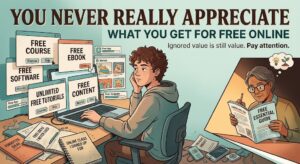
You Never Really Appreciate What You Get For Free Online
By : waytoearnformyfamily@gmail.com
Summary:
It’s true; you never really appreciate what you get for free online. Sure, you download the stuff; then more often than not file it and forget it !
It’s true; you never really appreciate what you get for free online.
Sure, you download the stuff; then more often than not file it and forget it.
Different story though when you shell out hard cash; then you value your download, you savour the content, you delight in your new found discovery, you anticipate the wisdom it is about to impart.
Then nine times out of ten…
1. You discover you already know all this stuff, or
2. You realize it is total hogwash, or
3. You have to shell out again for an upsell to make it work
Now you compare it with similar free stuff you downloaded earlier and are surprised to learn there is intrinsic value attached; value you failed to spot first time around – if you even bothered to look.
Free stuff can be good if it follows these criteria…
? It emanates from a genuine source of expertise in its genre
? It does not set out to sell you something you neither need nor want
? It contains content of genuine value
Free stuff can make you money when you dispense it yourself if…
? Your offer is presented in good faith
? Your offer does not attempt to persuade the recipient to make a complementary purchase
? Your offer provides a genuine solution with no strings attached
Above all resist the temptation to infest your offer with a proliferation of thinly disguised affiliate links; they will just hack off the beneficiary.
Free stuff will build you a priceless resource if…
All you ask in return for your free stuff is an email address where you can relay a message with the download link.
Treasure your flow of freely given email addresses; compile them daily into a priceless asset; your ever-growing voluntary optin list.
Now you can think about upselling…
Jim Green is an entrepreneur and bestselling author with an ever-growing string of niche non-fiction titles to his credit. http://free-stuff-xl.com
A few months ago, I was helping a friend launch his first online portfolio. He had exactly zero budget, so I spent an evening setting him up on a brilliant free hosting tier, connected a free sub-domain, hooked up a gorgeous open-source template, and integrated a free analytics script. It took under two hours, and the site looked premium.
Three weeks later, I checked in on him. “How’s the site going?” I asked. He shrugged. “Honestly, I haven’t looked at it since that night. I kind of forgot the password.”
I sat there staring at my coffee, completely dumbfounded. If he had paid a developer $1,500 and shelled out $150 a year for hosting, he would have been checking that dashboard every single morning. Because it cost him absolutely nothing, its psychological value to him was zero.
That interaction hit me like a ton of bricks. It made me look inward and realize a harsh truth about my own digital habits: we never really appreciate what we get for free online. We live in an era where some of the most advanced software engineering, creative tools, and educational libraries in human history are handed to us for the price of an internet connection. Yet, because we didn’t open our wallets for them, we treat them like disposable digital clutter. We sign up for free accounts, accumulate thousands of bookmarks, hoard open-source code, and let world-class tools gather virtual dust.
Let’s talk about why our brains are wired to disregard free digital value, the incredible tools we are actively taking for granted, and a practical framework to shift from a passive hoarder to an active creator using the free internet.
The Psychology of the “Zero-Dollar Trap”
Economists talk about a concept called the sunk cost fallacy—our tendency to follow through on an endeavor if we have already invested time or money into it. The inverse of this is what I call the Zero-Dollar Trap. When an item or service has a financial cost of $0.00, our brains unconsciously tag it as “low value” or “infinite supply.”
Think about your own digital behavior:
-
How many free PDF guides or e-books have you downloaded that you’ve never actually opened?
-
How many free online courses have you added to a “To-Watch” list on YouTube or Coursera that you haven’t touched in over a year?
-
How many free SaaS (Software as a Service) platforms have you registered for, only to completely abandon the tab ten minutes later?
When we pay money for something—say, a $50-a-month subscription to a premium design suite or a specialized text editor—we feel a psychological pressure to use it. We tell ourselves, “I need to make this money count.” But when a tool is free, there is no financial pain to motivate us. The barrier to entry is non-existent, which means the barrier to quitting is also non-existent.
The Mind-Blowing Value We Regularly Take for Granted
Let’s take a step back and look objectively at what the free tier of the internet actually gives us. If you tried to build or buy equivalents to these tools thirty years ago, you would have needed a corporate budget and a team of specialists.
1. High-Performance Web Architecture
Years ago, if you wanted to launch a website that could handle thousands of concurrent users safely, you needed to rent physical server space, understand complex command lines, and pray you didn’t get hit with a sudden bandwidth bill.
-
The Free Reality: Today, platforms like GitHub Pages, Vercel, Netlify, and InfinityFree allow you to deploy live web applications and landing pages globally in minutes, for free. They handle global Content Delivery Networks (CDNs), auto-scale your traffic, and provide free SSL certificates out of the box.
2. Enterprise-Grade Creative Design
There was a time when graphic design and media editing were locked behind massive paywalls. If you couldn’t afford a heavy monthly software license, you were stuck using basic MS Paint or pirating sketchy, unstable software torrents.
-
The Free Reality: Tools like Canva’s free tier let you design professional pitch decks, logos, and marketing materials with templates crafted by real pros. If you need heavy-duty vector work or photo manipulation, open-source giants like Figma, GIMP, and Inkscape provide professional features completely free of charge.
3. World-Class Automation & Multi-Tools
Think about the sheer convenience of text manipulation and utility tools. Need to convert thousands of lines of text from one layout to another? Need to change video formats instantly?
-
The Free Reality: Open-source tools like HandBrake, VLC, or online text transformers and unit converters handle heavy mathematical and rendering tasks on demand. We click a button, get our converted files in seconds, and don’t give a second thought to the years of programming hours poured into making those systems smooth and seamless.
How to Break the Cycle and Actually Leverage Free Tools
If you are tired of hoarding free resources without ever building anything real, you need to change your relationship with the free internet. You have to artificially create the psychological structure that money usually provides.
Here is the step-by-step framework I used to stop collecting free tools and start using them to generate real outcomes.
Step 1: Enforce a “One-In, One-Out” Software Limit
When you find a cool new free tool, your natural instinct is to sign up immediately and add it to your bookmarks. Don’t do this. Treating software like an infinite buffet leads to choice paralysis.
-
The Action: Pick a core stack of free tools for your specific goal (e.g., WordPress or Google Sites for web building, Wave for basic accounting, Notion for notes). If you want to try a new free tool, you must explicitly replace or delete an old one from your active workflow. Limit your active tool stack to what can fit on a single screen.
Step 2: Create “Artificial Skin in the Game”
Since the tool didn’t cost you any money, you need to attach a non-monetary cost to your failure to use it.
-
The Action: Tie the free tool to a public deadline or an accountability partner. Don’t just say, “I’m going to play around with this free app creator platform.” Tell a colleague or post on your social channel: “I am launching a simple custom web app prototype this Friday at 4 PM.” * The Result: The fear of public failure or missing a hard deadline replaces the financial motivation of a paid subscription.
Step 3: Track Your “Time Saved” as Revenue
When using free multi-tools, open-source automation scripts, or templates, start calculating how many hours of manual labor they are saving you.
-
The Action: Keep a simple running note of your digital efficiency. If a free automated text transformer or bulk image resizer saves you an hour of tedious manual copying and pasting, and your internal freelance rate is $30 an hour, that free tool just handed you a $30 dividend. When you look at free tools as financial multipliers, you start treating them with the respect they deserve.
Common Pitfalls: The Mistakes We All Make with Free Services
While the free internet is a goldmine, navigating it recklessly can cost you something far more valuable than money: your time and your data security. Here are the major blunders to avoid:
1. Falling for the “Data Harvest” Trap
Not all free tools are created equal. If a platform offers a highly complex service for free with no visible premium upgrade paths, no ads, and no obvious corporate backing, you are likely the product.
The Lesson: Always check who is behind a free service. Stick to verified open-source projects supported by transparent communities, or reputable companies offering genuine “freemium” tiers (where they offer a great free version hoping you will eventually scale up to their paid corporate features). Avoid sketchy, pop-up utility sites that require you to upload sensitive documents or personal financial spreadsheets just to perform a basic conversion.
2. Upgrading Prematurely Because of Vanity
Many SaaS platforms are designed to make you hit their free tier limits quickly, tempting you with features you don’t actually need yet. I’ve seen countless builders pay $29 a month for a premium email marketing tool because they wanted advanced automation funnels, despite having an audience of only 42 subscribers.
The Lesson: Treat your free tier limits like a badge of honor. Do not pay for a premium upgrade until your free infrastructure is literally bursting at the seams from real, revenue-generating usage. If a free tier allows up to 1,000 users or 5GB of storage, exploit every single bit of that capacity before you touch your credit card.
Shifting Your Perspective
The next time you open a high-quality free web application, download a robust open-source extension, or use a seamless online converter tool, take five seconds to pause. Look at the interface. Think about the clean code running in the background, the servers keeping it alive globally, and the developers who spent nights troubleshooting the exact features you are using for free.
The free internet isn’t valueless just because it lacks a price tag. It is a massive, democratic equalizer that gives anyone with an internet connection the leverage to compete with massive corporations. Stop collecting, stop browsing passively, and start building. Treat every free tool like a high-end asset, and you’ll be amazed at what you can actually accomplish without spending a single dollar.